
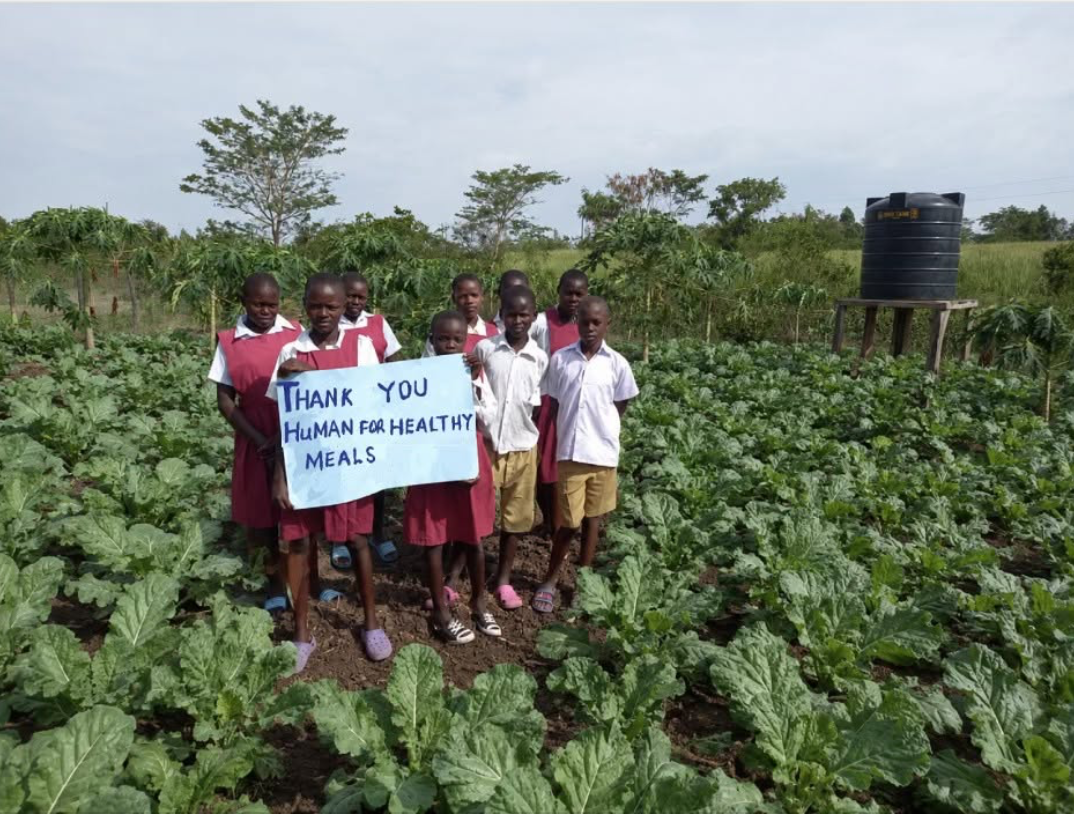
Kenya Report -- HuMAN Funded Farm Project Success and Harvest Report
by George Ongere - September 5, 2026
On April, Humanist Mutual AID Network funded farming project in our farm. We are pleased to report that the vegetable farming project supported through the previous funding was successfully implemented and harvested. The project enabled us to make productive use of the spaces available between the orchard rows at the HuMAN Farm by cultivating kales, tomatoes, and onions.
The harvest has had a direct and meaningful impact on the feeding program for the orphaned children, which was established by HuMAN. A significant portion of the harvested vegetables was allocated to the feeding program, providing fresh and nutritious food for the children while reducing the amount of money that the program would otherwise have needed to spend purchasing vegetables from the market.
The remaining produce was sold locally, generating income that can be directed toward supporting the children's educational needs.
Use and Distribution of the Harvest
We have used the farm primarily as a source of food for the children while also generating income to make the program more sustainable.
Based on the planned allocation:
60% of the produce was allocated to the feeding program.
40% of the produce was allocated for sale in the local market.
The produce allocated to the feeding program was used in preparing meals for the orphans. Kales, tomatoes, and onions are commonly consumed foods in our community and therefore provided both nutritional and practical value.
The produce sold generated funds that can be used to assist with educational expenses, including school fees, books, uniforms, and other school requirements.
Financial Outcome
The project has demonstrated that a relatively modest investment in farming can produce a significant return while simultaneously providing food for the children.
The projected gross return from the harvest was approximately US $1,500. After accounting for the US $600 investment required for the irrigation equipment and related project costs, the estimated net return is approximately US $900.
It is important to emphasize that the financial return does not represent the entire benefit of the project. A substantial portion of the harvest was consumed through the feeding program. Therefore, the project provided a dual benefit: it reduced food costs for the feeding program while also generating income to support the children's education.
Impact on the Orphans
The success of this project has strengthened our belief that agriculture can play an important role in making our charitable activities more sustainable.
The farm has helped us:
1.Provide fresh vegetables for the orphaned children's feeding program.
2.Reduce the cost of purchasing food from outside the farm.
3.Generate income that can be directed toward education.
4.Make better use of the available agricultural land.
5.Create a foundation for expanding agricultural production.
Most importantly, the project has shown that the farm can contribute directly to meeting the children's daily needs rather than depending entirely on external funding.
Looking Ahead
The success of the previous farming project demonstrates that investment in the farm can create a continuing cycle of support: funding enables production, production provides food and income, and the resulting benefits go directly to the children.
We are grateful for the support that made this successful harvest possible and look forward to building upon these results to create an increasingly sustainable source of food and income for the orphan support program.