
Dan Beaton’s Report on his Critical Thinking Workshops in Nigeria (October 2021)
Delivery of goods
Classroom resources were delivered to James Terungwa, including laminated handouts, pens, and projector for use in delivery of CT workshops in Benue State. Humanist Global t-shirts (sponsored by Contrado) were given to educators to take back to their respective states.
Meeting with Amina 24/10/2021
Discussion of situation with Mubarak Bala. Recommended course of action: as Nigerian authorities and governors are refusing to respond, maybe Humanist International could apply legal pressure on Facebook whose platform, in part, led to his detainment.
CT Workshop 1: 25/10/2021
This workshop took place at a standard comprehensive in Zuba. The class of 35 was a mixed age group school, including primary and secondary students. They undertook the new 13+ curriculum as found here completing lessons 1 (beliefs and justifications) and lesson 2 (questioning superstition).
The superstitious beliefs drawn into question included the belief that a woman lying on the road is likely a witch who has fell from the sky. Also, the belief that money would grow when planted were compared to more probable explanations. Students were shown how easy it is to trick people into believing supernatural claims through manipulation.
Note: The workshops are difficult to deliver if populated by students from too wide an age range. Ideally workshops should be aimed at 13-year-olds and over.
CT workshop 2 (26.10.2021)
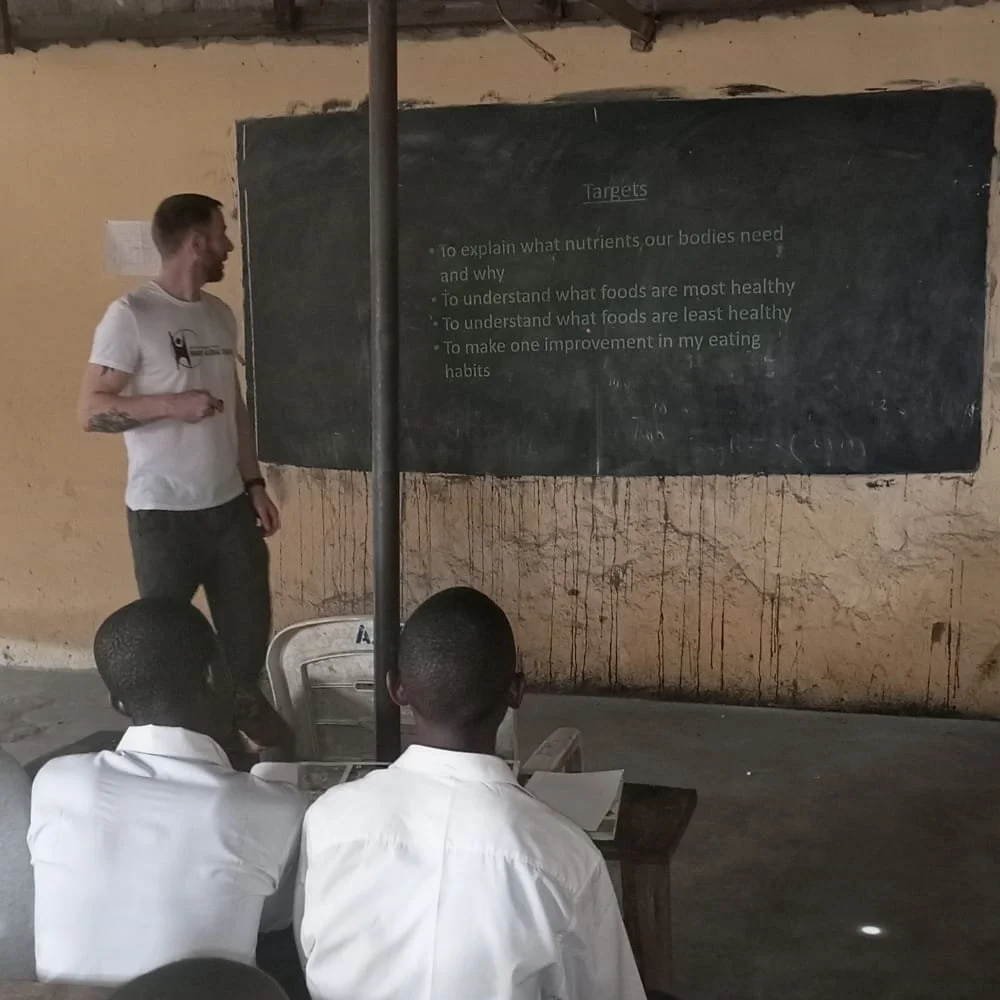
The following day we completed an additional CT session on medical interventions (found here). In this lesson, students used ‘object prompts’ recently developed by the London Science Museum giving learners a sense of how concepts of medicine and healing have changed over time -- from highly ineffectual charms to the development of vaccines. By the end of the session students could identify the types of justification which folk treatments relied upon (personal experience and confirmation bias) and authority/testimony ( a folk belief is simply based on from generation to generation without rigorous testing).
After examining a range of historic and alternative prophylactics and remedies (from rabbit’s feet and statues of healing gods/saints) and comparing these to local folk beliefs most students could identify that the best solutions to disease out breaks are those using modern medical interventions such as PPE and vaccination.
The next session was on nutrition. We promoted a return to traditional African diets over Western fast-food diets. Students tasted healthy snack alternatives and made a health pledge. Students were shocked to discover Coca Cola is not a nutritional requirement.
Note: the teachers requested junk food for the students, but I refused to permit this because it went completely against what we were teaching.
Training (28.10.2021)
Due to inability to secure a school in time, James and I spent this day on training, reviewing resources, etc. Discussion points: cultural problems in understanding examples used in slides and how to integrate SDGs into our curriculum.
Sexual health workshop (29.10.2021)
The second school was in Madalla, Abuja. The school staff seemed quite resistant to critical thinking due to concerns it focused on religion and might undermine faith. I was subjected to hostile interrogation by a Muslim teacher. He said he will not tolerate anything that undermines the word of god.’ I replied that I was unclear as to which god he was referring to and that a true religion has nothing to fear from the pursuit of truth. He then claimed that truth is relative and human reason cannot be trusted.
Given the grilling, we instead focused on sexual education. This was a large group of around 70-80 students. We explored the impact of STIs, the concepts of consent and the impact of unplanned pregnancies on parents, the child, and the broader community. All this was done under the caveat that sex is not a shameful act. This class was led by Amina with James Terungwa attending as part of training. The class were highly engaged and could detect myths about sex. There was a prize giving at the end of this session, including clothes and sanitary products.
In my future trips I will make secure schools in advance. We also need a generic description to email or WhatsApp to the schools, so they know exactly what Critical Thinking is in advance.
Future suggestions
• Obtain UN funding if we can segue with SDGs. Overheads quickly spiralled when relying on taxis to get to school. Also when everyone demands to be paid for us teaching.
• Gift giving to all students can cause classroom chaos. I think simply distributing sanitary products and maybe some stationary is better.
• The contact details of Humanist Global Charity are needed on the slides.
P.S I would like to thank the Gardners Trust for the Blind who helped with cost toward my portable ergonomic solution teaching solution, which enabled me to complete my work overseas.

——————————————

Report from Dan Beaton on teaching Critical Thinking to students in Jaipur, India
With many schools closed and global travel heavily restricted during the covid crisis, Humanist Global Charity have faced limited opportunities to deliver critical thinking classes in 2020-2021. We have, however, made use of online teaching. We have also been working on creating resources for other educators to access.
In October 2020, critical thinking sessions commenced via zoom with students at the Neerja Modi School in Jaipur, India (a school keen to incorporate a module on critical thinking into their IB program).
Our CT teacher Dan Beaton delivered 8 sessions to 3 separate groups of students, with a total of approximately 45 students attending the online course until its completion in June 2021.
The sessions focused on beliefs and their justifications; evidence, and superstitions; identifying fallacies and psychological biases, and modern misinformation.
During the session on superstitions, students noted common features of folk beliefs around the worlds and explored the origins of these beliefs, notably in tradition and authority. Students were also able to see the role that confirmation bias, the placebo effect and the Barnum effect have in sustaining such superstitions once they are inculcated. A range of local superstitions were identified from the relatively harmless injunctions such as ‘do not cut nails after sunset’ to dangerous practices such as the tradition of baby tossing. Many such traditions and beliefs were seen as most common in the student’s grandparent’s generation and as such ‘on their way out’.
Nonetheless beliefs concerning caste were viewed as more incorrigible, as were beliefs like the sanctity of the cow as embedded within wider religious traditions.
In another lesson students worked on identify sources of misinformation in the media and developing their ability to identifying fake news, viral texts, and bad science reporting. Much of our discussion focused on conspiracy theories surrounding covid-19 and vaccinations. One group decided to focus their group work on a how the media in India still normalises child marriage.
A testimonial by one of the students at Neerja Modi School called Prannat claimed,
“The classes were great! Everything was explained explicitly, and the slides were concise. I thoroughly enjoyed the sessions and my favorite topics were fallacies, mental errors and biases, and justifying beliefs. I came across various ways in which a belief can be justified and how to critically analyse and then come to a conclusion.”
———————————-
Critical Thinking Report 13-18 February 2022, from Uganda
by Dan Beaton
Critical Thinking Workshop 1: Ssekezza Primary School The first CT workshop took place at Ssekezza Primary School near Mpigi. Roughly 30 children attended and appeared to be around 12 years old. Learners in this group were below the target age for our designed curriculum and many had problems understanding English (or at least my accent). Assistance was provided by the head teacher: She was very cooperative and clearly explained points in the local language.
Some unusual beliefs that were questioned included the illuminati and the existence of mermaids
Critical Thinking Workshop 1: St Lawrence Crown City
The second workshop took place in St Lawrence Crown City with around 45 learners. Unfortunately, the cohort of learners appeared to be again below my target age of 14+. Given the difficulty in securing age-appropriate cohorts, it is essential to develop a workshop for younger learners.
Some of the beliefs questioned included:
• ritual sacrifice in which an uncircumcised child of five years is taken to a witch doctor (referred to as a ‘jjaja’) to be sacrificed for riches
• a compound fracture can be healed through a voodoo style ritual involving breaking a chicken’s leg then putting it back together causing the human bone to heal
• a Jjaja can control the weather and stop the rain through a fire and spear ritual
There was some confusion as to whether identifying a justification for a belief is sufficient to show it is false (it is not) and many students and teachers it seems almost wanted a straightforward trouble shooting method for judging beliefs. I revised some of the resources in response to confusions like these.
David Oloo secured these two schools and helped deliver a session. David has an interest in delivering further workshops and is an experienced teacher with access to regions outside of Kampala.
Critical Thinking Workshop 3: Kampala Student Centre
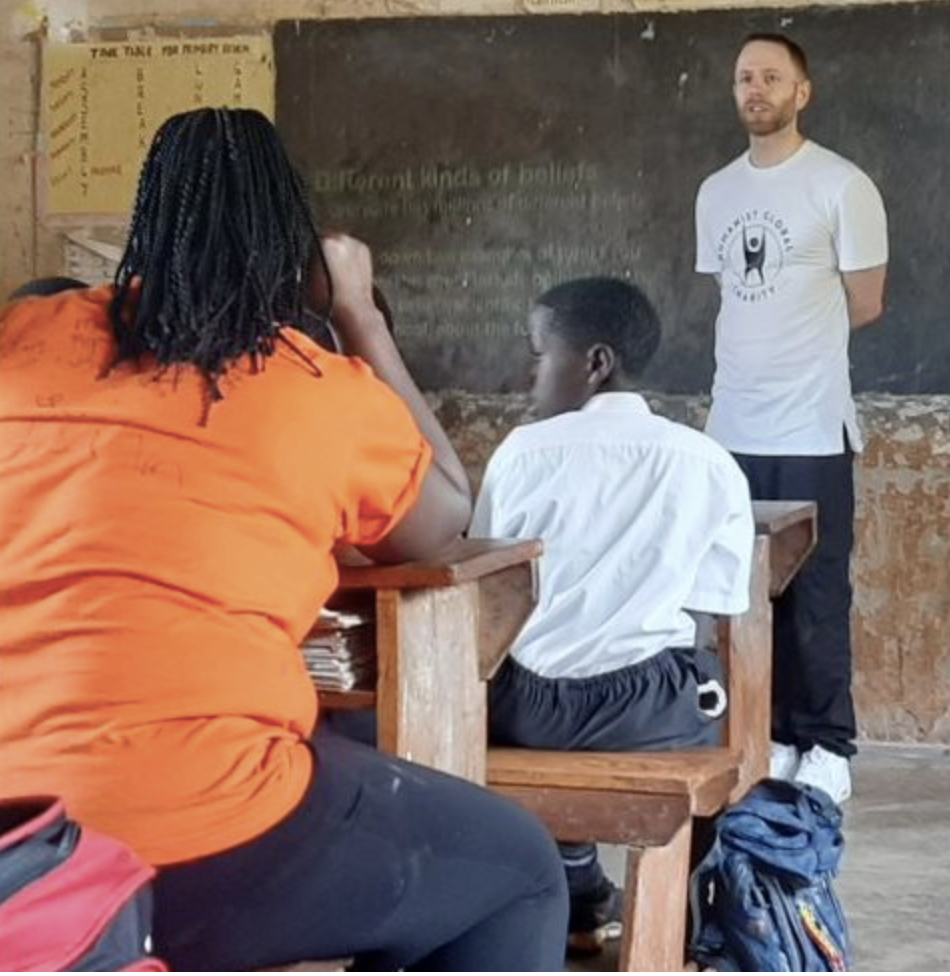
The next workshop was held in Kampala. The school was the former school of Mukasa Kato author of The God Business and the Death of Reason in Africa. The school caters to students from a poor background yet has a distinguished alumni. The school however has been hard hit by two years of lockdown and torrential rain, leaving it in a state of disrepair and only a small student cohort. They are desperately seeking funding. This workshop was delivered to 12 students and four members of staff
Kato was impressed by the even-handed and non-confrontational nature of the workshop. However, after the session I realised students often got confused with evaluating justifications for beliefs. For example, one student evaluated science simply as a technological enterprise (for example citing the problem that smart phones make us antisocial), instead of seeing how poor science reporting and poor quality studies can lead us to false beliefs.
Critical Thinking Workshop 4: Bright Way Hill School (Kampala)
The final workshop was the most successful, delivered to the whole student body of a larger secondary school. Though my projector did not work, the students were engaged and curious.
Beliefs that were critical examined included:
• Europeans cannot contract HIV
• Covid-19 was created to reduce the black population
• the Illuminati exists as devil worshippers and engage in blood sacrifice for fortunes –this is proved by Lil Naz marketing stunts involving alleged human blood shoes
• wanting something to be true makes it true (to be distinguished from positive thinking as a motivator to action)
• faith is persuasive reason to believe to those who lack that particular faith
Other general discussions included:
• the post hoc ergo propter hoc fallacy and its role in supporting supernatural beliefs, including spontaneous remission of disease and the placebo effect – how they trick us into inferring false causation
• extraordinary claims require extraordinary evidence - using the example of time travel as a comparison point for more common beliefs
• presenting evidentialism - what evidence for miracle healing would be sufficient to demonstrate a claim
Training Session
Viola Namyalo of Ugandan Humanist Association has a background in sexual health education. We reviewed resources and stationery was also delivered. Though the slides are a great guide for educators to then splice with their own superior local knowledge, using a projector isn’t practical as the only projector owned by the organisation is now in Nigeria. Valuable resources to bring in the future would therefore include large chalks and a portable white or black board. More pens and paper and worksheets would encourage more active participation for learner who, in an African schooling context shaped by an outdated colonial model, often just sit and passively listen.