
Why Humanism is Needed in My Country, Nigeria
by Saliu Olumide Saheed
Nigeria is a country of immense beauty, diversity, and potential. Known as the "Giant of Africa," it is home to over 250 ethnic groups, countless languages, and vibrant cultures. With its vast natural resources and young, dynamic population, Nigeria could be a leader on the global stage. Yet, the reality for most Nigerians is far from this ideal. The country struggles with corruption, inequality, ethnic and religious divisions, and poor governance challenges that have made life difficult for millions. While solutions often seem elusive, one philosophy offers a clear path forward: humanism.
Humanism, at its core, is about placing human well-being and dignity at the center of our values. It emphasizes reason, compassion, and fairness, rather than dogma or discrimination. In a country as complex as Nigeria, these principles can serve as a guide to address our most pressing issues and unlock the potential of every citizen.
Fighting Inequality and Promoting Justice
One of Nigeria’s biggest challenges is inequality, which defines many aspects of life. From education to employment opportunities, a person’s tribe, gender, or background often determines their prospects. Ethnic and regional divisions have created a sense of "us versus them," with some groups enjoying privileges while others are marginalized. Women, despite their significant contributions to families and communities, face systemic barriers in education, politics, and the workforce.
Humanism offers a remedy by insisting that every person has intrinsic value, regardless of their identity or status. It promotes fairness and equal opportunity, pushing for policies that uplift everyone, especially those left behind. For Nigeria, embracing humanism means creating a society where no one is excluded based on where they come from or who they are. It is about building a country where every Nigerian can thrive, regardless of their circumstances.
Tackling Corruption with Accountability
Corruption resonates deeply in Nigeria, and for good reason, it is one of the most significant obstacles to progress. Corruption has seeped into every level of society from inflated government contracts to bribes for basic services. It has eroded trust in public institutions and left many Nigerians disillusioned with leadership.
Humanism emphasizes integrity and accountability. It calls on leaders to prioritize the common good over personal gain and encourages citizens to hold their government to higher ethical standards. If Nigerians embrace humanist values, we can begin to create a culture where honesty and transparency are celebrated, not undermined. Leaders must lead by example, and the people must demand better. Humanism empowers citizens to reject corruption and insist on governance that benefits everyone, not just a select few.
Bridging Religious and Ethnic Divides
Nigeria’s diversity is one of its greatest strengths, yet it has often been a source of division. Religious and ethnic tensions have fueled violence, destroyed communities, and deepened mistrust between different groups. Whether it is clashes between Christians and Muslims or disagreements between ethnic groups, these conflicts have left scars on the nation’s history.
Humanism offers a way to move beyond these divisions. It teaches us to focus on our shared humanity rather than the differences that separate us. By promoting mutual respect and understanding, humanism can help Nigerians build bridges across divides. Imagine a country where people of different religions and ethnicities work together to solve common problems, guided by the belief that what unites us is stronger than what divides us.
Education as a Catalyst for Change
Education is one of the most powerful tools for transforming society, but Nigeria’s education system is struggling. Many schools are underfunded, teachers are underpaid, and students often lack the resources they need to succeed. Even when education is accessible, it sometimes emphasizes rote learning rather than critical thinking or creativity.
Humanism places a high value on education not just as a way to gain employment but as a means of personal growth and societal progress. A humanist approach to education would prioritize teaching children to think critically, solve problems, and question the status quo. This kind of education could produce a generation of Nigerians ready to tackle the country’s toughest challenges, from climate change to unemployment. It would also empower young people to dream big and innovate, unlocking the potential that lies within Nigeria’s vibrant youth.
A Vision for Nigeria’s Future
At its heart, humanism is about building a better world by putting people first. For Nigeria, this means creating a society where everyone is treated with dignity, leaders act with integrity, and citizens work together to solve problems. It means rejecting divisions and focusing on the values we all share: compassion, fairness, and the belief that every life matters.
Nigeria is a nation with incredible potential. Its rich cultures, brilliant minds, and resilient people have the power to transform not just the country but the entire continent. But to achieve this, we must embrace a new way of thinking one that prioritizes humanity over hatred, reason over division, and unity over conflict.
Humanism isn’t just a philosophy; it’s a lifeline for a country like Nigeria. It offers a vision of a future where everyone can thrive, where problems are solved with rationality and compassion, and where we all work together to create the Nigeria we dream of. By embracing humanism, we can turn our challenges into opportunities and build a country that truly reflects the greatness we aspire to.
————————
Accelerating growth in Africa: the role of technology and innovation
Saliu Olumide Saheed
In a blog post at the later part of 2018 written and published by the Brookings Institute it was asserted that 70 per cent of the world's poorest people live in Africa. Also, 27 out of the 28 world's poorest countries are in sub-Saharan Africa, while 1 in 3 Africans lives below the global poverty line. For a continent endowed with numerous natural resources, as well as a swelling population that can provide all the human capacities needed to turn these resources into beneficial products with maximum utilities, the above statistics are very humiliating. But this is not a recent trend.
Africa has been synonymous with penury for a long time. We could claim that the Europeans and their supremacist's activities during the colonial era darkened our ways and underdeveloped our continent. But the years of colonialism have passed. We now rule ourselves, work our destiny and decide our future. It is no longer sane to point fingers. Rather, we must look inward for solutions and most importantly; we must look towards science, innovation and technology.
The journalist Meredith wrote in his terrific book, Born in Africa that "Africa does not give up her secrets easily". Anyone who has ever thought about the continent really hard will be confronted with the truism of that statement in every sphere of the African life. Up to the most recent discoveries in paleontology, coupled with the myriads of archaeological evidence, which demonstrated that the first humans to have ever existed, lived in Africa, it would have been impossible to suggest that. But we now know that they do.
African hunter-gatherers apparently formed the first human communities to waddle the surface of Africa. They were unprotected from the brute forces of nature. At that time, lots of lives were lost from using taste to discern which plants were edible and those who weren't. Since there was no form of medicine, Individuals were more susceptible to diseases and plagues than ever, and with shelter and accommodation not being a real necessity, it follows that people were attacked by beast, cold, extreme heat and lightning when it rains. The list of their perilous situations can go on and on to show how vulnerable and helpless their situation was. Such was their condition until a major revolution happened.
In line with the Israeli Jewish professor of history, Yuval Noah Harari, who wrote in his magnum opus Sapiens that "Humans rose to a significant organism because of three revolutions". The cognitive revolution (which is immaterial to our case), the Agricultural revolution and the scientific revolution. Our cognitive revolution was uncaused since it was guided by the blind hand of natural selection, while the Agricultural revolution was a fruit of our hands. It is the basis of all civilization. It taught us all an important lesson, which is the fact that we can innovate and produce a technological product to solve most of our problems. From the crude practice and subsistence agriculture came the plough, came the hoes, giant knives, giant silos and even pyramids. We eventually had a civilization, one, whose light shone upon the whole world and became a model for other distant people to learn from. And they did learn!
Western civilization boomed. The scientific revolution of the 16th and 17th century took place on their soil. More than ever, the miraculous method of solving problems and innovating useful technologies was born. Antibiotics were discovered, the train was invented, the thread mill, electricity, standardized printing press, the television, the transistor radio, space satellites for communications, dynamite, nuclear energy and radioactivity. Within a short period, they had a series of industrial revolutions and even exported their technologies elsewhere. Africa on the other hand, relented from their core values and methods to engage in frivolities. The resulting situations were ravaging. Slowly, the civilization and glamorous Africa we've once created, decayed and deteriorated on our own eyes.
Innovation, as it occurred to me, is the production or transformation of materials and ideas to solve human problems. When these new ideas are in the form of materials, they can be called technology, and science is the tool by which these endeavors are carried out. When human problems are solved and diminished, A country progresses. When a country progresses, it can be said to have grown. To accelerate growth in Africa will be to tighten our relationship with science and our human capacities to innovate. We have arranged things in such a way that to distant ourselves from innovation and technologies is to be silent about our problems and in the not too distant time, such a mixture of complacency and delinquency is bound to explode. We can only hope such an explosion will not tear Africa upon itself.
In our fervor for accelerated growth. Africa needs to first ameliorate themselves from their culture of total dependency and take responsibility for their problems. Political answers and policies are never enough. In almost all developed countries, science, innovation and technologies are the vehicles that drive all their sustainable development programs. To improve our food security, get clean water, provide maximum communications, energy for all industries, modern and efficient health care, good quality of life and high standard of living, everything all depends on our investment and the extent to which our technology can cater for us. Maybe there is nothing wrong with buying technologies, maybe there is even nothing wrong in sending students to other countries and learning how to make some of these things. One fact still remains very certain, it is almost impossible to progress as a nation without innovation and technology. Even as egregious as it is that science can fascinate us all, only technology and innovation can "give us a new world.”
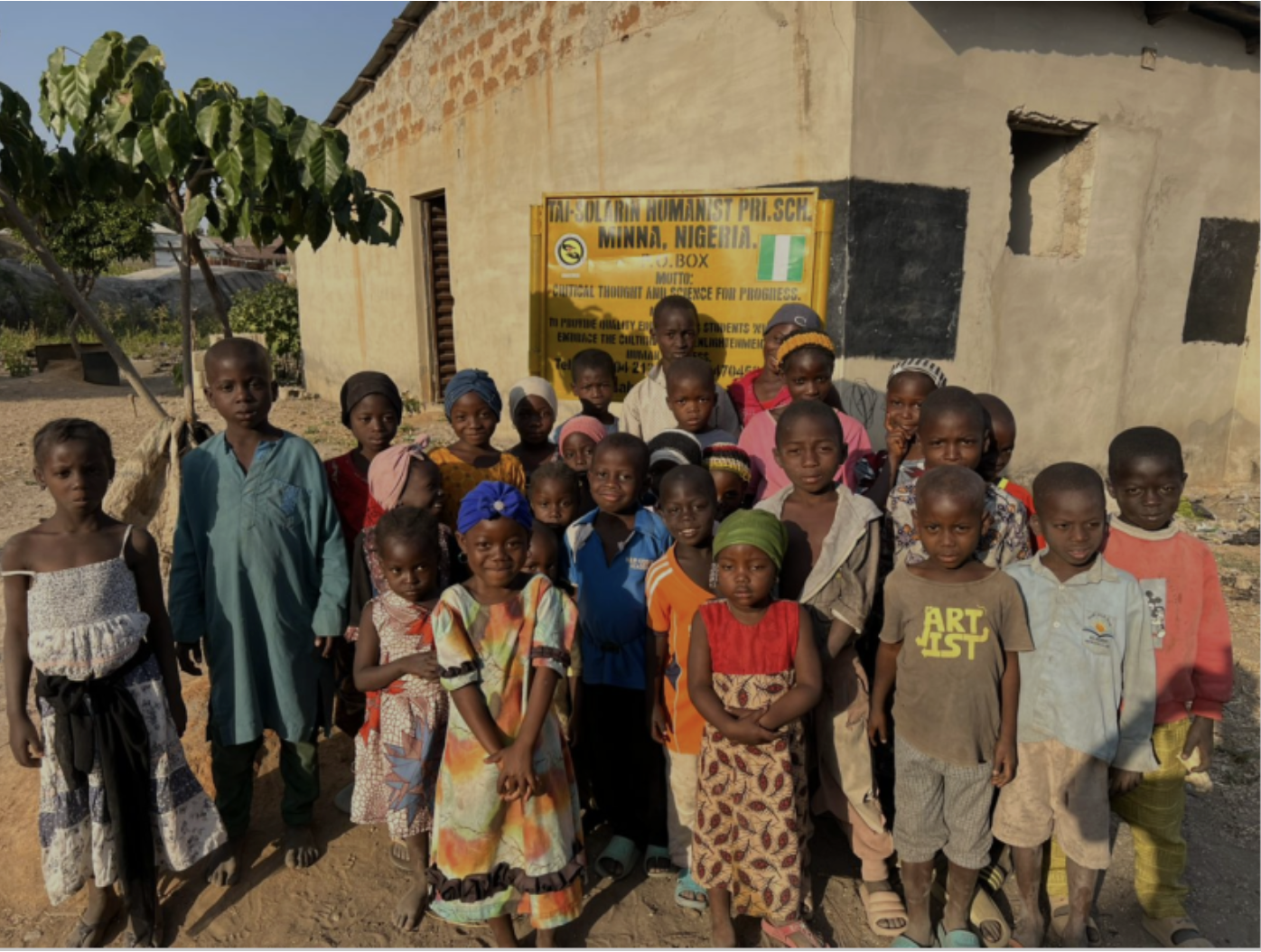
THANK YOU Note from Tai Solarin School for Computer Equipment
Dear HuMAN,
On behalf of the Tai-Solarin Humanist Primary School in Maikunkele, we extend our heartfelt gratitude for your generous support throughout 2024. Your provision of the recent $300 has been transformational, allowing us to purchase two Chromebook laptops, a projector, and a screen for digital learning.
The joy and excitement among the students are immeasurable! These tools have opened a new world of opportunities for them, bringing lessons to life in ways they had never experienced before. The children are eager to explore and learn, and their smiles are a testament to the positive impact of your kindness.
Thank you for believing in our mission and for empowering these young minds. Your generosity has truly made a difference, and we are deeply grateful.
With warm regards,
Saliu Olumide Saheed
Tai-Solarin Humanist Primary School