
Niger: Women's Leatherwork Vocational Centre
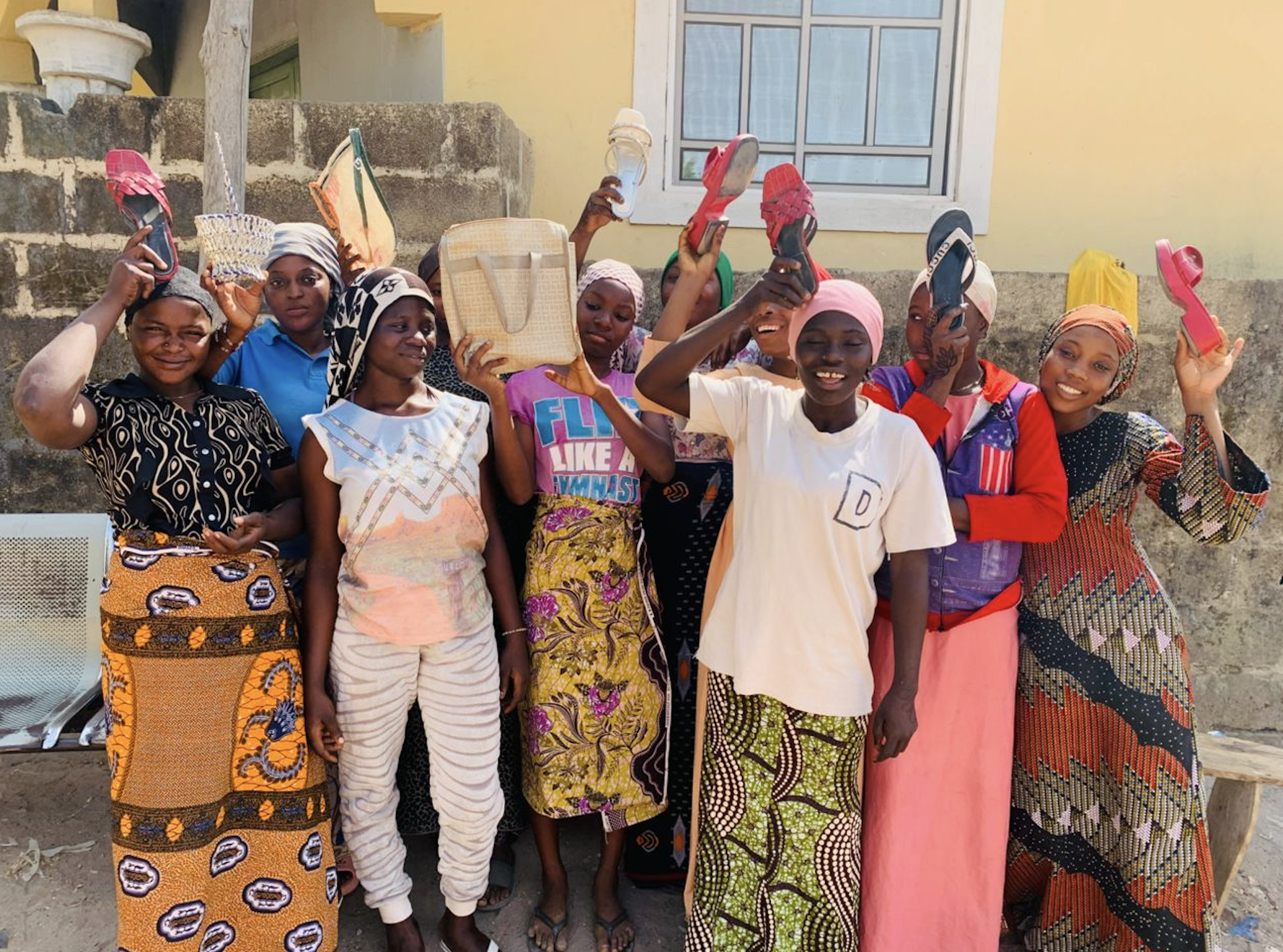
Niger: Women's Leatherwork Vocational Centre
Women’s Leather work Vocational Centre
Niamey Humanist group
Niamey, Niger-Republic
Members:
Jamila Kaka Niamey -27- ifeyyyay@gmail.com
Aïcha Abdoulaye – 22 – aicha.abdoulaye22@gmail.com
Zara Mahamane – 19 – zara.mahamane19@gmail.com
Hassana Issoufou – 24 – hassana.issoufou24@gmail.com
Mariam Garba – 21 – mariam.garba21@gmail.com
Fati Soumana – 20 – fati.soumana20@gmail.com
Rabiatou Adamou – 23 – rabiatou.adamou23@gmail.com
Hadiza Dan-Koulou – 18 – hadiza.dankoulou18@gmail.com
Salamatou Harouna – 25 – salamatou.harouna25@gmail.com
Safi Oumarou – 22 – safi.oumarou22@gmail.com
Fatoumata Djibo – 26 – fatoumata.djibo26@gmail.com
Email: ifeyyyay@gmail.com
Phone: +22792451836
What does humanism mean to you?
It means rejecting religion, Leaving the idea of a God and spirituality to science, reason and logic. For Me, humanism is not a philosophy I discovered in a book; it’s something I slowly recognized in myself as I grew up in the warm, dusty rhythm of Niamey’s streets. It means believing that ordinary people like my neighbors in Yantala, my classmates at Abdou Moumouni University, the women selling millet in the market carry a dignity and worth that don’t depend on tribe, religion, or status.
Humanism, for me, is what I feel when I help my little cousins with homework under the dim courtyard light and see their eyes brighten at a new idea. It’s that quiet conviction that education can open doors, even when the world around me sometimes feels heavy with economic hardship or social expectation. It means that when I walk along the Niger River and watch the pirogues drifting by, I believe that every person steering those boats has a story that matters, that every life has value simply because it is lived.
Humanism is also the way I navigate the tension between respecting my family’s traditions and listening to my own thoughts. I don’t reject the culture I grew up in; I just want to build a version of it where compassion, reason, and equality have more space. I dream of a Niamey where girls don’t have to justify wanting an education, where choosing your path isn’t an act of rebellion but an act of being fully human.
Most of all, humanism gives me a sense of agency. It tells Me: “Your life is your own. You can shape it. And you can help shape the lives around you.”
Humanism, to me, is ultimately a simple truth: People matter, and what we do for one another matters most.
Project Description
The Humanist Women’s Leatherwork Vocational Centre in Niamey, Niger, is a small but transformative initiative designed to empower young humanist women through practical skills and economic independence.
With an initial budget of $1,200, the project will establish a simple yet fully functional leather-craft workshop where women can receive hands-on training in creating high-quality leather goods such as wallets, belts, bracelets, sandals, and handbags. By focusing on a craft that is culturally relevant and locally profitable, the centre provides a realistic pathway for women to generate steady income in a challenging economic environment.
For the humanist community, this centre serves a deeper purpose. It is not just a vocational space it is a safe, supportive environment where humanist women can gather, learn, and grow without fear of judgment or pressure to conform to restrictive expectations. Many young women in Niamey who identify with humanist values of autonomy, equality, and rational thinking often lack spaces where their voices are honored and their choices respected. The centre will help fill that gap. It will give them a place to build confidence, strengthen their independence, and connect with others who share similar beliefs about human dignity, compassion, and self-development. Through collaborative work and shared learning, the centre will become a small community hub where humanist values are lived out through cooperation, respect, and mutual support.
The funding will be used to purchase essential leatherworking tools, raw materials, and basic workshop furniture so that the centre can begin training immediately. Participants will learn practical skills such as pattern making, cutting, stitching, dyeing, and finishing, which they will apply to produce marketable leather items. These products will be sold in local markets and community fairs, helping trainees earn income even during the training phase. Additionally, the centre will offer simple business and financial literacy lessons, enabling the women to price their products, manage small budgets, and understand how to maintain a sustainable micro-enterprise.
Over time, the Leatherwork Vocational Centre will help 10–15 humanist women gain practical skills, with many expected to begin earning money from their craft within the first six months. A small portion of the revenue from sales will be reinvested to replenish materials and maintain tools, creating a self-sustaining cycle. As the project grows, it has the potential to evolve into a cooperative led by the women themselves, giving the humanist group greater visibility, unity, and long-term stability in Niamey.
In essence, this centre will not only teach a trade it will nurture a community. It will give humanist women a space to stand together, support one another, and build livelihoods rooted in dignity and self-determination. It becomes both a vocational pathway and a statement of empowerment: a place where humanist women in Niamey can shape their futures with their own hands
Budget (Total: $1,200)
Leather materials (hides, offcuts, dyes, thread) – $350
Leatherworking tools (cutters, punch sets, stitching kits, edge tools) – $450
Workshop setup (tables, chairs, mats, lighting, storage) – $200
Training materials (manuals, notebooks, photocopies) – $80
Local transport & participant outreach – $50
Marketing & sales setup (packaging, market booth fees, online pages) – $70
Total: $1,200
Expected Income from Project, with Timeline
The project is expected to begin generating income within the first two months as trainees start producing simple leather items such as keyholders, bracelets, and small wallets, which can be sold in local markets for $2–$5 each, bringing in an estimated $60–$100 per month during the early stage. By months 3 to 6, as participants gain confidence and begin producing higher-value items such as belts, sandals, and handbags, sales are projected to rise to $150–$250 per month, allowing the centre to reinvest in materials while providing small earnings to trainees. By the end of the first year, once product quality improves and a small customer base is established, the centre is expected to reach a steady monthly income of $250–$350, creating a financially sustainable cycle that supports ongoing training and helps humanist women achieve long-term economic independence.
Benefits to your Community
Empowers humanist women with vocational skills and financial independence.
Creates income-generating opportunities for trainees, boosting local economic activity.
Fosters a supportive humanist community where women share knowledge and encouragement.
Promotes gender equality by giving women practical tools to participate in the economy.
Encourages entrepreneurship through small-scale leather product sales.
Preserves and develops local craft skills, connecting tradition with modern markets.
Builds self-sustaining initiatives that can grow into cooperatives or small businesses.
Strengthens social cohesion by involving families and local markets in the project’s success.
Provides a safe, inclusive space for personal growth, learning, and collaboration.